The Shepherd’s Path · No. 02
The Shepherd's Staff
We keep a container of staffs at the front of our church. They get handled a lot.
A few years back I gave a prophetic word to a woman about God calling her into leadership. She had been sitting with it for a while and wasn't sure what to do with it. I asked her to pick up one of the staffs. She did, and I watched something change in her. Her posture altered. It wasn't that she suddenly looked confident in any visible way. It was quieter than that. Something settled in her, and it was as though God's authority had come to rest on her the moment her hand closed round the wood. She stood in it. She knew what she was carrying.
I've thought about that moment a lot. There's something about a physical object in your hand that reaches a place words don't always reach.
More Than a Walking Stick
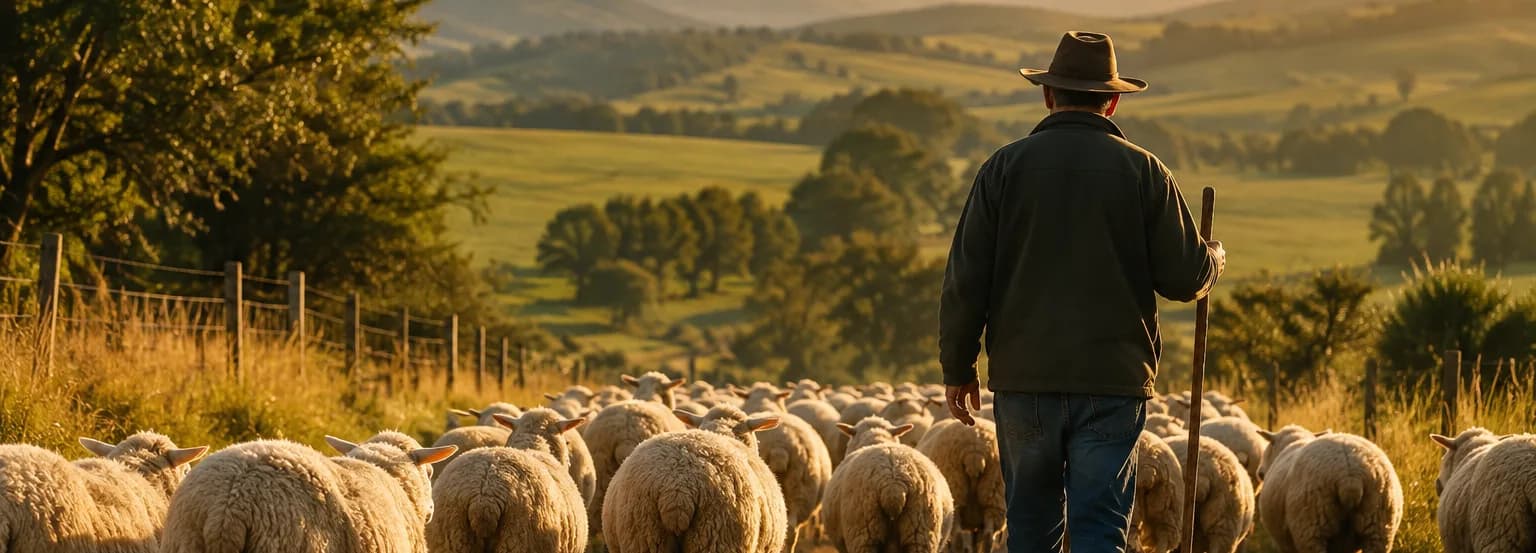
Psalm 23 is the psalm most people know. Or think they know. The rod and the staff in verse four tend to get read past quickly. They were working tools. The rod was for predators. The staff was for guiding sheep, pulling them back from a cliff edge, getting them out of a hole, steadying the shepherd on rough ground. Neither was ceremonial.
Even though I walk through the darkest valley, I will fear no evil, for you are with me; your rod and your staff, they comfort me.
— Psalm 23:4 (NIV)
Moses is the other example that keeps coming to mind. His staff is all through the Exodus account. He used it to turn the Nile to blood. He raised it over the Red Sea. He struck the rock at Horeb and water came out. It was an old shepherd's stick. What happened through it had nothing to do with the wood. It had to do with God, and with Moses being willing to do what he was told when he was told to do it.
That part is easy to miss when you're reading the story quickly.
Knowing the Country
A farmer who doesn't know the land or territory, will lose stock. Not because they don't care. Just because they don't know where the cliffs are, or where the water dries up in summer, or which paddocks have gorse. You can't shepherd country you don't know.
I've watched church leaders who were very capable organisationally. Good at managing, good at conflict, good at running things. And over time the congregation hollowed out. People were attending but not really being fed. The leader was busy but not particularly prayerful, and it showed, not all at once, but gradually.
A shepherd who isn't connected to God will eventually find they're just moving people around rather than actually leading them anywhere.
Not All Shepherds Come from the Same Place
Some leaders are formally trained. Years of theological study, supervised placements, careful formation. That matters. There are good reasons we don't let people perform surgery without training.
Others came into leadership without planning to. A crisis came and they stepped up, or someone named a gift they hadn't seen in themselves, or they ended up responsible for something they couldn't walk away from. Moses is that story. He was looking after his father-in-law's sheep in the Midian desert, eighty years old, when the burning bush appeared. He had a speech impediment. He told God at length why somebody else would be a better choice. God listened and then told him to go anyway.
I find that encouraging. Not everyone who picks up the staff feels ready to hold it.
What tends to mark the ones who lead well over a long time, whether trained or not, is that they don't behave as if the flock belongs to them. They know they're looking after something that isn't theirs.
Counting Sheep
Farmers count their stock. You need to know the numbers. But a good farmer also looks at the animals themselves, are they moving freely, eating well, putting on condition. Numbers only tell you part of the story.
Churches count too. Attendance, giving, how many programmes are running. Some of that counting is useful. But I've seen congregations that looked healthy on paper and weren't. People were showing up and not much more than that.
Jesus said the Good Shepherd calls his own sheep by name (John 10:3). That's worth sitting with. Not tallying them. Knowing them.
The families nobody quite knew how to include. The ones who'd been hurt and were sitting at the back to see if it was safe. The ones who'd stopped coming and nobody had noticed. Those people don't show up in the attendance figures.
Old Methods, New Ground
Every generation of the church has the argument about tradition and new approaches. It tends to get more heated than it needs to.
I've been around long enough to have seen both sides of it cause damage. Tradition that got treated as though it was the faith itself, not just a form of it. And new methods that turned out to be novelty with a scripture verse attached.
Figuring out which is which, takes discernment, and discernment isn't fast. It usually involves getting some things wrong first.
Moses carried the same staff he'd used to tend sheep in Midian. He took it into situations he could never have anticipated. The staff didn't change. The ground under his feet did.
We All Hold Staffs
Here's something that tends to get missed. The staff isn't only for the person standing at the front.
Every believer has been given authority. The Father placed it in your hand when you came into His Kingdom. It wasn't a loan. It wasn't conditional on how you performed or how confident you felt. It was given. Full stop.
My husband Paul had a word once that stayed with me. He looked out at a room full of people and said, simply: dust off your staff. That was it. Not a long word. But people wept when they heard it, because they knew exactly what he was talking about. They'd set something down. They'd let it gather dust, not because God had taken it back, but because somewhere along the way they'd stopped believing it was really theirs to carry.
The enemy doesn't need to take what God has given you if he can simply convince you to leave it in the corner.
There's a whole company of believers right now who are carrying authority they aren't using. They've been through enough that picking it back up feels presumptuous. Or they've watched others wield authority badly; as power, as performance, as entitlement, and they've quietly decided they don't want anything to do with it. That's understandable. It's also a mistake.
Authority given by the Father for the sake of the Kingdom doesn't stop being needed just because you're tired of how some people have handled it.
So dust off your staff. Take it up. Stand in what God has placed in your hand and fight the good fight with everything you have. Not to prove something. Not to earn something. Because the ground you're standing on needs someone willing to stand.
That's you. It has been all along.
What Staff Are You Holding?
Some of you reading this have been given a leadership role, formal or informal, and you're not sure you belong in it. That's not a comfortable place to be. Moses spent a fair bit of time there too.
Some of you are watching your leaders, and not always kindly. I'd ask you honestly: are you praying for them? Not as a thing you're supposed to do. Actually asking God to hold them up, to give them what they need, to carry some of what they're carrying. Leadership in the church takes more out of people than most of the congregation sees.
And some of you put down something God gave you and haven't gone back for it. Something happened, you got hurt, or discouraged, or you convinced yourself it wasn't really yours to carry. It's been a while now.
God hasn't forgotten what He placed in your hand. He's still there, and He's still asking.
The shepherd's staff in our church container is just a piece of wood. What happens when someone picks one up and means it, that's a different thing altogether.
May we be people who pick it up and mean it.
For Reflection
Is there something God placed in your hand that you've put down? What would it take to pick it up again?
Are you genuinely praying for the leaders in your church?
Who in your congregation might not be showing up in the numbers, and do you know them by name?
A short letter, now and then.
News of new writing and books, plus a free copy of When Life Hurts — 7 Truths That Will Help You Find Strength, Hope and Purpose Again to welcome you.
Subscribe on SubstackFree, and you can unsubscribe whenever you like.